

Underfloor Heating on Timber Floors: The Insulation Question Answered
Quick answer: Installing underfloor heating beneath a timber floor works well, but the system performs noticeably better when a purpose-made insulation board sits underneath the heating mat/element. Without one, a portion of the heat generated by the system travels downward into the subfloor rather than upward into the room. A Marmox insulation board creates a thermal barrier that keeps heat moving in the right direction, which affects warm-up time and running costs. Below, we explain what is actually happening inside the floor and what the NZ Building Code now requires.
A Question That Comes Up in Every Timber Floor Renovation
Once a homeowner has decided they want underfloor heating under a timber floor, the next question is usually about whether they need anything underneath the heating mat/element itself. Some assume the heating system does all the work on its own. Others have heard that insulation boards are necessary but are not sure why, or whether they really make a difference.
The difference is real, and it comes down to a straightforward physics problem.
Where the Heat Goes Without Insulation
A heating mat/element installed directly onto a subfloor without any insulation beneath it generates heat in all directions. The idea is for that heat to travel upward, through the floor finish, and into the room. The problem is that without a barrier in place, heat also travels downward into the subfloor and dissipates there rather than doing any useful work.
Marmox insulation boards are placed between the subfloor and the heating system specifically to address this. The board acts as a thermal barrier, ensuring the energy generated by the heating mat is directed upward rather than dispersed into the substrate below. According to Warmup NZ, adding Marmox insulation boards can save up to 50% of the heat that would otherwise be lost through the floor in a conventional underfloor heating setup without insulation.
That saving shows up in two ways: the room heats up faster, and the system runs for less time to maintain the target temperature, which reduces ongoing electricity use.
What Marmox Actually Is
Marmox multiboard is an extruded polystyrene board reinforced on both sides with fibreglass mesh and a cement polymer mortar layer. It has a compressive strength of 40 tons per square metre, so it does not compress under furniture, foot traffic, or normal household loads over time.
The board’s structure is completely waterproof. The XPS closed-cell core does not absorb moisture and will not rot, which matters in rooms like bathrooms and kitchens where moisture is part of daily life. Marmox also reduces sound transmission by up to 20 decibels, which is a practical benefit in upstairs rooms or spaces above garages and basements.
Smart heating for Comfort and Efficiency
With the insulation board in place, a timber floor achieves a 2-degree temperature increase every 10 minutes from the point the system is switched on.
That is a useful number to hold onto when thinking about scheduling. Warmup NZ’s wood and laminate heating system is effective within two to six hours of being switched on, so running it on a programmed schedule rather than switching it on and off manually is the approach that works best in practice. The Warmup thermostats are pre-programmed from the factory with a typical household schedule, so the system starts managing both comfort and running costs from the day it is installed. Every 1-degree reduction in temperature during an eight-hour period delivers a 2% saving in running costs, which adds up meaningfully over winter.
How the Warmup NZ System Goes Together
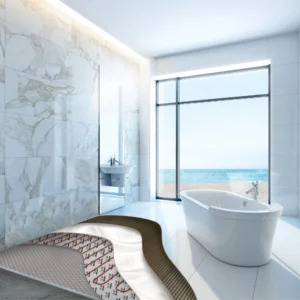
Warmup NZ’s wood and laminate heating system uses foil-based heating mats, which distribute heat evenly across the floor area. The installation builds in layers. The subfloor is prepared to be level and free of dust, dirt, and grit. The Marmox insulation board goes down next. The foil heating mat is installed over the Marmox, and should cover at least 90% of the surface area to be heated. The floor finish, whether engineered wood or natural wooden floorboards, goes down on top.
A floor sensor is placed between the wires of the foil pad during installation. It monitors surface temperature in real time and communicates with the Warmup thermostat to make sure the temperature beneath the timber never exceeds 27°C. Warmup NZ recommends operating the system at 24°C for the best balance of comfort and efficiency.
The system is 100% waterproof, carries no protruding cables or hardware at floor level, and is certified to New Zealand and international standards. Running costs are comparable to, and often less than, a heat pump. The system comes with a five-year warranty. Connection of the heating mat to the thermostat must always be done by a qualified electrician.
Final Thoughts
Underfloor heating works well under timber floors. Adding a Marmox insulation board underneath the heating system is the step that makes it work at its best, directing heat upward where it belongs rather than losing it into the subfloor, improving warm-up times, and reducing what the system costs to run. For new builds and most renovations, it also brings the installation in line with current NZ Building Code requirements.
If you are planning a timber floor renovation and want to understand which system and board thickness suits your room, get in touch with the Warmup NZ team on 0800 WARMUP, email info@warmup.co.nz, or visit warmup.co.nz to request an estimate.
Share this post
Related Posts

Keep the heat in: how to reduce heat loss in your home